

Financial Sector Deepening Uganda’s 2025 account of a small-business recovery fund gives conflicting lending figures, an unexplained credit multiplier and employment claims whose basis is unclear.
The Micro and Small Enterprise Recovery Fund is a partnership with the Mastercard Foundation that channels finance through smaller financial institutions. THe nonprofit organisation has described it as a facility worth about $26mn. It aims to protect 100,000 jobs and create 150,000 more.
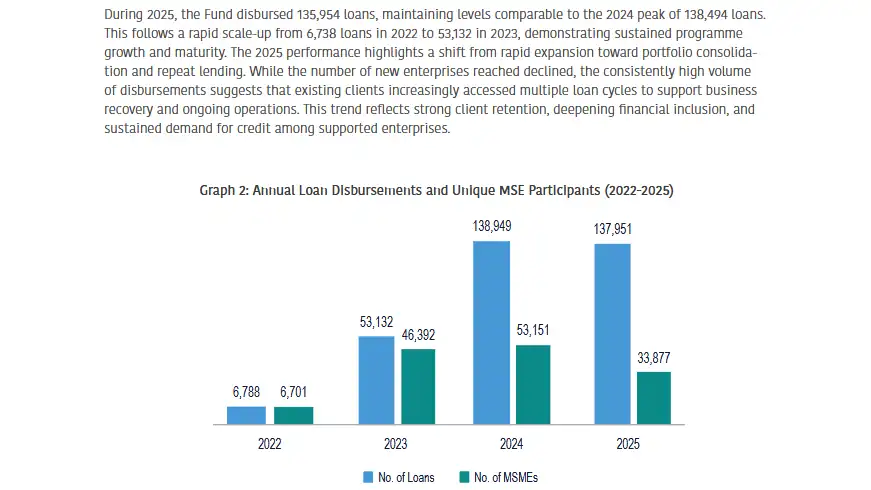
Yet the report’s account of lending in 2025 disagrees with a graph on the same printed page.
The text says the fund made 135,954 loans to 39,877 enterprises. Graph 2 gives 137,951 loans and 33,877 enterprises. The report does not say which figures should be used or explain the difference.
The report says Shs99.3bn was provided to participating financial institutions and Shs381.2bn was on-lent to businesses, describing the result as a credit multiplier of 4.82 times. Dividing the second published amount by the first gives 3.84 times. FSD Uganda may have used another denominator or formula, but the report does not provide one.
The report says the fund reached 146,009 “unique” micro and small enterprises from 2022 to 2025. A shop that borrowed in both 2024 and 2025 should count once in that four-year figure. The report does not explain whether it counted such businesses once or twice.
The distinction matters in a programme built partly on repeated, short-term lending. The report says one unnamed digital lender, PFI A, made 80,652 loans in 2025. Its detailed account says the lender reached 2,123 unique customers; the executive summary, on the other hand, gives 1,060 enterprises. It does not explain whether these measures differ or which represents the lender’s reach.
Repeated disbursements can make a fund’s loan count and total lending value look large even when fewer distinct businesses receive finance. The report itself says participating institutions largely used the fund’s capital directly rather than attracting additional commercial funding. Loan volume alone cannot establish whether borrowers’ businesses recovered.
FSD Uganda acknowledges problems with the records. Its 2025 data-quality audits found duplicate loan IDs, mismatched national identification numbers and weak connections between lenders’ systems and the fund’s Portfolio Monitoring Tool. The report says these findings prompted data cleaning, process changes and staff training. It does not say whether the conflicting published totals were reconciled after that work.
The report’s jobs figures are also hard to follow. It says the fund supported 220,689 youth employment opportunities by the end of 2025, including 24,862 new jobs, and compares that total with 124,876 in 2024. But the table beside the claim labels 220,689 as a “weighted midline” figure. The report does not explain which figure is the valid starting point for measuring jobs created.
The report says 98 per cent of surveyed businesses were still operating a year after receiving credit. But it does not say how many businesses were surveyed or what happened to those the researchers could not reach later. FSD Uganda has published a separate 2025 resilience and survivability survey page, but the annual report does not provide those details alongside its claim.
This website sent FSD Uganda detailed questions on 16 October and followed up on 19 October, requesting a response by 5pm on 20 October. It had received no answer at the time of writing. It also sought comment from the Mastercard Foundation and ASIGMA Capital, the facility manager. Neither organisation had responded at the time of writing.
For readers accustomed to seeing private-sector credit as a monthly macroeconomic indicator, the fund should offer a view of what lending looks like in practice: which businesses borrowed, how often, on what terms and with what result. Its annual report does not provide a clear enough account to answer those questions.
FSD Uganda may hold reconciled figures and methods that explain these discrepancies. Until it publishes them, readers cannot assess the fund’s reach and results with confidence.
FSD Uganda and its partners should provide a corrected results table, define how distinct borrowers and new jobs were counted, and explain what its data-quality findings changed in the published figures.