


The National Social Security Fund recently announced that it is paying an interest rate of 12.3% on member contributions for the last financial year. NSSF has since credited accounts of its members with the interest amount, according to a Saturday notice.
Though last year’s rate is lower than the 13% paid for 2014/2015, it is still the third highest rate the fund has paid over the last ten years. The highest was 14% for the 2007/2008 financial year. NSSF’s interest rate is determined by the returns on its investments.
| NSSF interest rates for the last 10 years | |
| Financial Year | Interest Rate |
| 2006/2007 | 7% |
| 2007/2008 | 14% |
| 2008/2009 | 3% |
| 2009/2010 | 7% |
| 2010/2011 | 6% |
| 2011/2012 | 10% |
| 2012/2013 | 11.23% |
| 2013/2014 | 11.50% |
| 2014/2015 | 13% |
| 2015/2016 | 12.30% |
Most of the funds’ investments are fixed income investments, according to unaudited financial statements for the six months ending 31st December 2015. These include fixed deposits in commercial banks, treasury and corporate bonds, mortgage finance, and corporate loans. The second highest category is investments in stock exchanges in Uganda and the region.
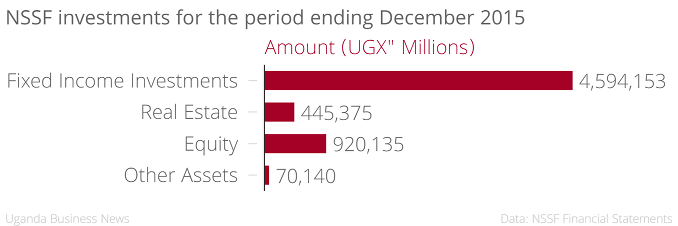
Not only is the fund the largest investor in Uganda, it is also the biggest player on the Uganda Securities Exchange, with shareholding in all but two of the local listed companies, according to the December statements. The only local companies it had not invested in were NIC Holding Ltd and British American Tobacco Uganda.
The fund is mandated by an act of Parliament to provide social security services to employees in Uganda if their employers meet certain requirements (the NSSF Act also allows voluntary contributions from employers who do not meet the requirements). Most employees are members of NSSF by default, as a result, with a portion of their earnings invested in the fund.
But, what if you were asked to choose between contributing to the NSSF and investing in the stock market? Your first concern would be the rate of return of either investment: which of the NSSF and the USE offers better returns?
We set to find out, looking at the last six financial years due to two reasons. First, NSSF’s financial year follows the government financial year, which runs from July to June. Second, market statistics on the Uganda Securities Exchange website go back only up to the start of 2010.
We assumed Shs1 million invested with the stock exchange at the start of July 2010 and the same amount contributed to NSSF at the end of financial year 2009/2010 (NSSF computes interest based on the opening balances of the members’ funds at the beginning of the financial year for which the interest is paid).
How much would you have at the end of June 2016?
The average NSSF interest rate for the last six years is 10.67%. Compounding a Shs1 million contribution at a 10.67% annual rate of return will grow it to Shs1,837,297 after 6 years. This means you’d have an earned Shs837,297 after the latest interest is credited to your account.
On the stock exchange, we assumed the Shs1 million was invested in the USE All Share Index. The ALSI measures the performance of all stocks listed on the USE, which are currently 16 (including eight cross-listed stocks). It opened at Shs1023.82 in July 2010. A Shs1 million investment would have bought you 976.73 shares.
At the close of June this year, when NSSF closed its books for the financial year, it stood at Shs1706.68. Subtracting 1706.68 from 1023.82 gives 682.86. 682.86 x 976.73 shares equals 666,969.85. Therefore, the gain in six years would be Shs666,970, which is less than what you would have earned in the NSSF.
| Changes in the ALSI, 2010-2016 | ||
| Opening July 2010 | Closing June 2011 | % Change |
| 1023.82 | 1122.31 | 9.62% |
| Opening July 2011 | Closing June 2012 | |
| 1122.31 | 1046.53 | -6.75% |
| Opening July 2012 | Closing June 2013 | |
| 1046.53 | 1481.38 | 41.55% |
| Opening July 2013 | Closing June 2014 | |
| 1481.38 | 1696.84 | 14.54% |
| Opening July 2014 | Closing June 2015 | |
| 1696.84 | 1995.63 | 17.61% |
| Opening July 2015 | Closing June 2016 | |
| 1995.63 | 1706.68 | -14.48% |
The calculations show that the NSSF has outperformed the USE All Stock Index over the last six years, with contributions growing by 83.73% versus the ALSI’s returns of 66.7%. Despite the NSSF’s more impressive returns, there is a limitation to how a member can contribute. Also, to be fair to the USE, we did not factor in the dividends paid by listed companies.