
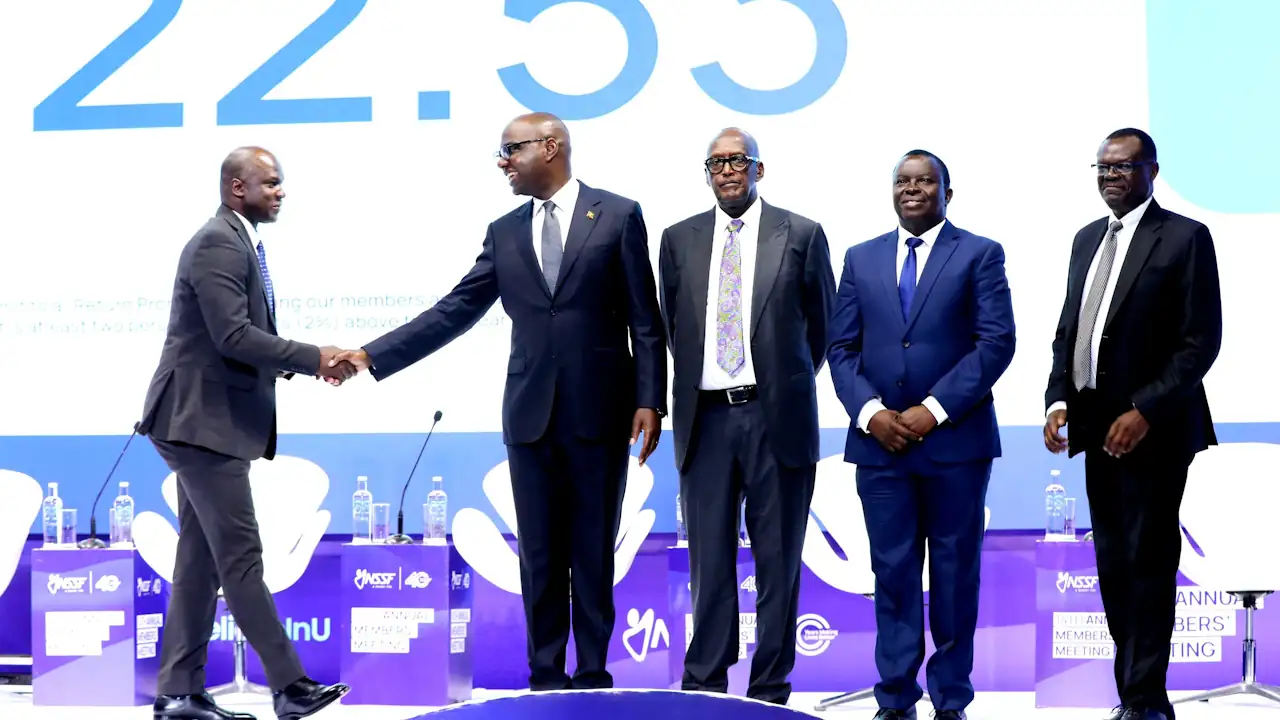

Uganda’s National Social Security Fund will credit its members with 22.53 per cent interest for the year to June 2026, the highest rate in its history and half as much again as the previous record of 15 per cent, set in 2017/18. Henry Musasizi, the finance minister, announced the rate on Thursday at the fund’s 14th annual members’ meeting in Kampala. Members will share Shs5.44tn, nearly double last year’s Shs2.79tn.
The rate is more than 18 percentage points above annual inflation of 3.7 per cent in June. It is also well above the 14.5 per cent that the fund’s cash earnings could support [by our reckoning on Wednesday]. The difference came from gains the fund has yet to realise.
According to its 2026 integrated report, NSSF earned total income of Shs6.5tn in 2025/26. Of that, Shs3.9tn was realised income from bond interest, dividends and rent. The remaining Shs2.6tn, 40 per cent of the total, came from unrealised gains on investments and currency movements, which exist only on paper until the assets are sold, as we noted last week.
The payout is Shs1.6tn larger than the fund’s entire realised income. Of Shs6.2tn in profit before interest and tax, 87 per cent has been credited to members. After a tax bill of Shs338bn, that leaves the fund roughly Shs450bn, on our calculation.
Where the money came from
The fund’s shares returned 60.8 per cent over the year, against 25.2 per cent in 2024/25. According to the report, the gains came mainly from rising share prices at CRDB, MTN Uganda, Airtel Uganda, NMB and KCB, and equity holdings grew by 74 per cent to Shs5.9tn. NSSF raised its equity allocation to 18.4 per cent of the portfolio, from 13.3 per cent a year earlier. Fixed income returned 16 per cent, up from 14.1 per cent.
In each of the previous three years, the payout was smaller than realised income. The report describes the board finance committee’s role as recommending the interest rate “depending on the fund’s realised income”. Last year the committee recommended a rate “based on the fund’s realised income and financial performance”, and the Shs2.8tn declared came to about 89 per cent of cash earnings.
Neither the report nor the finance ministry’s statement says what rate the board recommended this year. In 2018 the board proposed 13.5 per cent and Matia Kasaija, then finance minister, raised it to 15 per cent.
A thinner cushion
Unrealised gains belong to the fund until they are credited. Once they sit in members’ accounts they become balances NSSF must honour, whatever markets do next. The accumulated member fund rose by a quarter to Shs31.9tn, against total assets of Shs32.9tn. About Shs1tn now separates members’ balances from the value of the assets behind them, roughly 3 per cent of the portfolio. Financial services make up 47.4 per cent of the equity book and telecoms 40.4 per cent, according to the report. A sharp fall in regional share prices, or in either sector, would erode that cushion quickly.
Mr Musasizi said members’ savings “must remain protected” and be invested through “commercially viable, professionally appraised and prudently governed investments”. Henry Tumukunde, the gender, labour and social development minister, who oversees the fund, went further. “This is a financial institution,” he said. “It must run on the rules and competitiveness of a proper financial institution.”
Next year’s arithmetic
Interest is calculated on balances at the start of the year, and those are now Shs31.8tn. On the method we used on Wednesday, a rate of 13.5 per cent, last year’s level, would cost about Shs4.1tn, more than the fund’s entire cash income this year.
More than 77 per cent of the portfolio sits in interest-bearing assets, and the fund’s own risk register warns that a significant decline in interest rates “could materially reduce investment income”. Treasury bill yields fell from 12 per cent to 10.4 per cent between June 2025 and August 2026, as we reported last week.
If realised income rises by 15 per cent and the fund again pays out 89 per cent of it, members would earn about 13 per cent. Anything higher would depend, once more, on markets.
NSSF members close to retirement will bank this year’s windfall. The rest should view it as the result of an exceptional year for regional equities and adjust their expectations for next year accordingly.