
The Bank of Uganda has ordered commercial lenders to lodge a larger share of their deposits with the central bank, the second such increase in six months, as the shilling trades at its weakest in about two and a half years.
A circular dated 15 September raises the cash reserve requirement from 11 per cent to 13.5 per cent, effective from the reporting cycle beginning 24 September. In March the ratio rose from 9.5 per cent to 11 per cent. Together the two moves take 4 percentage points of deposits out of the banks’ hands.
The requirement obliges banks to hold a set share of customer deposits at the central bank rather than lend it out. Regulators use it to steer the supply of credit and money, and to keep a liquidity buffer in the banking system. The circular gives two purposes: liquidity management and the transmission of monetary policy. It does not mention the currency.
The central bank’s official mid rate stood at Shs3,930.0 to the dollar on 18 September, against Shs3,779.8 on 31 August and Shs3,619.7 at the end of 2025. That is a fall of 3.8 per cent in under three weeks and 7.9 per cent this year.
Analysts disagree about the cause. Citi told Bloomberg that offshore investor positioning, rather than domestic fundamentals, was driving the move, and that domestic politics posed the greater risk. Absa’s economists said the central bank had “remained on the sidelines”, meaning it had not sold dollars to slow the fall. BMI, a Fitch Solutions company, blamed delays to the start of oil production and cut its forecasts: it now sees the shilling averaging Shs3,753 this year, against Shs3,665 before, and Shs3,791 in 2027.
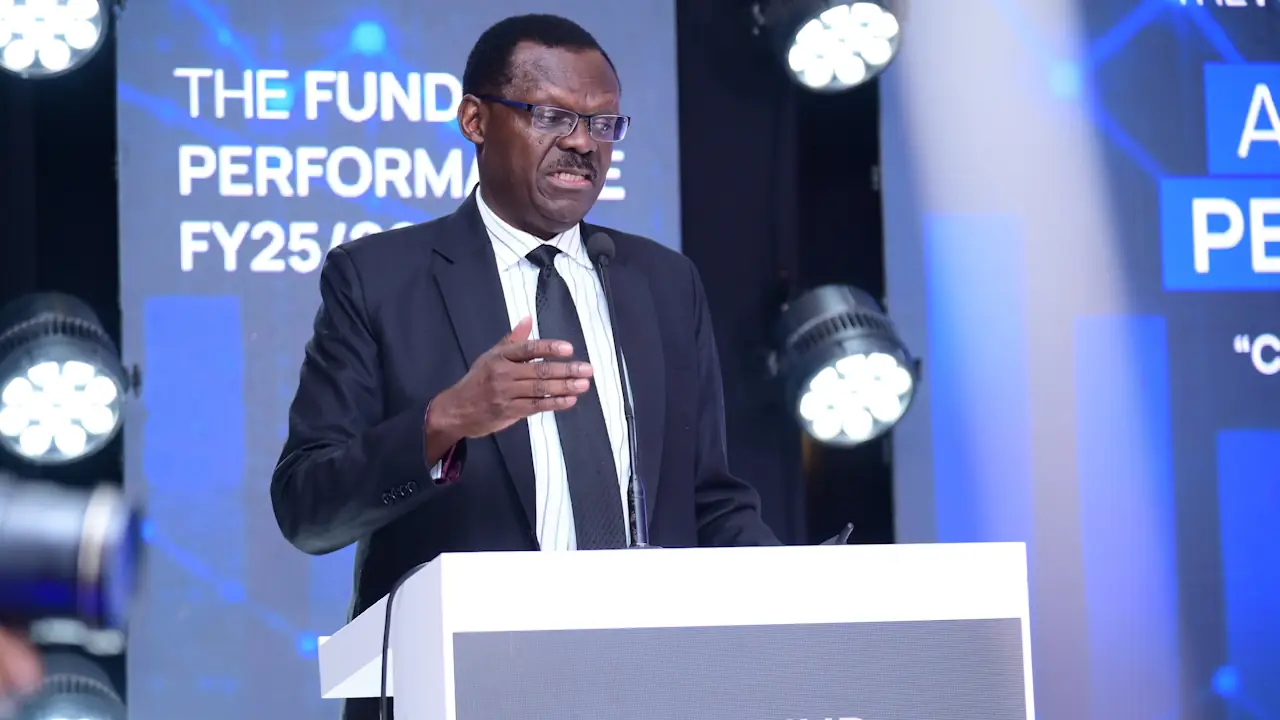
The governor, Michael Atingi-Ego, addressed the slide at the Uganda Bankers’ Association’s ninth Annual Bankers Conference, held at the Kampala Marriott Hotel on 18 September. The currency, he told bankers, “began to depreciate quite significantly” towards the end of the previous week, and he pointed to global oil prices. It was, he said, “a market determined currency”.
He drew parallels with three earlier episodes. When advanced economies began raising interest rates in 2022, capital flight took the shilling from about Shs3,650 in February to just short of Shs3,900. In August 2023, after the World Bank froze new lending to Uganda because of its anti-LGBTQ law, it came within reach of Shs4,000.
In February 2024, bond issues by Kenya caused it to reach Shs4,000. “We weathered it,” he said of the last two episodes. The shilling was now trading at about Shs3,930, and “Bank of Uganda has what it takes to stabilise this exchange rate.”
The central bank’s most recent view was more relaxed. Its August monetary policy statement said that “exchange rate pressures have also eased” and held the Central Bank Rate at 9.75 per cent.
The first upside risk it listed to inflation was a round of tightening by foreign central banks. The US Federal Reserve raised rates by a quarter of a percentage point on 16 September. The bank forecast headline inflation of 5.5 per cent to 6 per cent over the next 12 months. The Uganda Bureau of Statistics put the August figure at 4.1 per cent, with petrol prices up 28.5 per cent on the year.
Liquidity is a plausible motive. Banks were already flush: by the end of March, liquid assets equalled 57.2 per cent of deposits, against 42.9 per cent in September 2024, while loans stood at 56.2 per cent of deposits, according to the central bank’s financial soundness indicators.
Base money rose to Shs17.4tn in July from Shs15.1tn in June. Currency in circulation accounted for Shs453.6bn of the Shs2.3tn increase; on a rough reading the remainder is deposits that banks hold at the central bank. Reserves stood at $6.6bn, or 3.7 months of imports, and the trade deficit narrowed to $210mn from $591mn in June. Those are July figures, before the latest slide.
The increase in the cash reserve requirement in March did not coincide with a stronger shilling. The currency averaged Shs3,568.2 in February and Shs3,730.5 in March, when the ratio rose to 11 per cent, and monthly averages stayed between Shs3,704.5 and Shs3,764.1 through August. Whether a second increase behaves differently depends on whether the extra reserves drain shillings that banks would otherwise use to buy dollars, the usual argument for the tool, or leave the currency to find its level.
BMI expects the Monetary Policy Committee to raise the Central Bank Rate to 10 per cent on 12 November. If the slide continues, it sees three other options: selling reserves, raising the reserve requirement again or calling an extraordinary meeting.