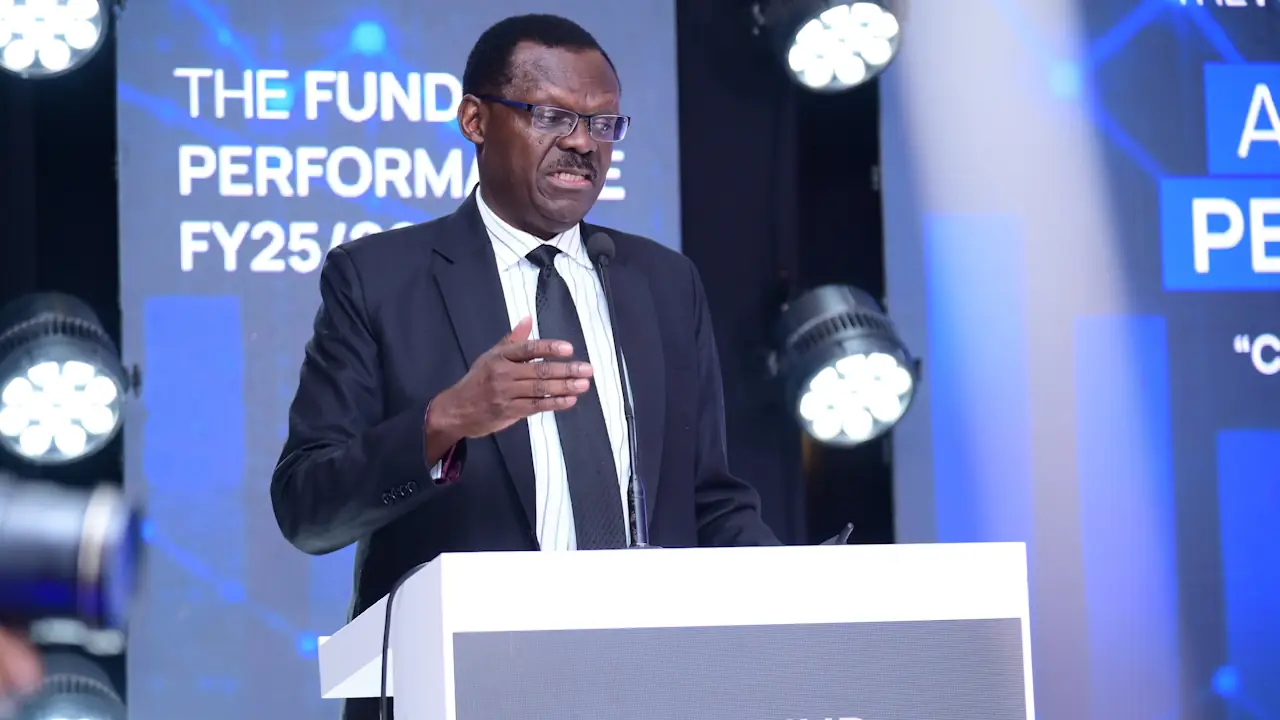

Patrick Ayota took the NSSF job in August 2023 after more than a year of a bruising contest between his former boss, Richard Byarugaba, and line minister Betty Amongi.
Corporate politics is a contact sport. Yet the NSSF melee was more like a cage fight that drew in political godfathers and meddlesome board members, and pitted Byarugaba against his deputy, Ayota.
Under Byarugaba, NSSF had delivered a record 15 per cent interest on members’ savings in FY2017/18, beating the previous record 14 per cent that David Chandi Jamwa had delivered and that had stood for a decade. Unsurprisingly, many savers saw his departure as a loss for the Fund and their pension pots.
As he prepares to announce last year’s full numbers and the all-important interest rate on Thursday, Patrick Ayota shows few scars from that cage fight, is bullish, and has the chance to write his own history with a record-beating interest rate after a strong year in equities and fixed income.
In 2023/24, Ayota’s first year in charge, NSSF printed 11.5 per cent, shaking off the Covid-induced drag of 9.65 per cent in 2021/22 and 10 per cent in 2022/23. In 2024/25, Ayota boosted his credentials with 13.5 per cent, which was the highest interest rate since that 15 per cent. This week he has a chance to meet and beat the record and his old boss.
Inside the sausage
First, a look past the sizzle, and into the meat of the matter. Analysis of the preliminary numbers announced by management last week shows that NSSF can comfortably print 14.5 per cent in interest to members’ savings.
For the year ended June 30, 2026, NSSF reported total income of about Shs6.5 trillion, up 85 per cent from Shs3.5 trillion in the previous year. Assets under management rose from Shs26 trillion to Shs32.8 trillion, while realised income increased from Shs3.13 trillion to Shs3.88 trillion. Member contributions reached Shs2.42 trillion and benefits paid rose to Shs1.55 trillion.
To put this performance in perspective, we need to distinguish realised revenue (money from bond interest, dividends and property income) from total income (which, in addition, also includes non-cash items like market-value and foreign-exchange gains or losses). Only cash can be distributed, so for our analysis, the metric that matters most is realised revenue.
Cash coming in through the door could increase even if the value of the Fund’s holdings drops. This is what happened in 2022/23 when total income was Shs1.158 trillion due to a share price slump as well as foreign exchange movements, yet NSSF’s realised income rose to Shs2.2 trillion. In the following year, realised revenue grew by 15 per cent to Shs2.53 trillion in tandem with total income which rose to Shs3.2 trillion as share prices recovered.
The key number to watch, therefore, is how much of the cash it prints NSSF gives to its members. Of the Shs2.53 trillion in 2023/24, NSSF distributed Shs2.07 trillion to members at an interest rate of 11.5 per cent. In 2024/25 realised revenue increased 24 per cent to Shs3.13 trillion. NSSF declared 13.5 per cent and allocated Shs2.79 trillion to members.
Last year’s unaudited numbers show a Shs747 billion increase in realised income, on the back of increases in interest income (by about Shs612 billion to Shs3.49 trillion) and dividend income (by about Shs131 billion to Shs369 billion) to bring realised income to Shs3.88 trillion.
Member returns, 2022/23 to 2025/26
Cash earnings grew steadily; market gains made 2025/26 exceptional
Shs tn unless stated
| Financial year | Realised revenue | Total income | Assets | Rate (%) | Interest allocation |
|---|---|---|---|---|---|
| 2022/23 | 2.20 | 1.16 | 18.56 | 10.0 | 1.58 |
| 2023/24 | 2.53 | 3.18 | 22.13 | 11.5 | 2.07 |
| 2024/25 | 3.13 | 3.52 | 26.01 | 13.5 | 2.80 |
| 2025/26* | 3.88 | 6.51 | 32.80 | 14.5–15.25* | 3.50–3.68* |
*2025/26 income and assets are preliminary management figures. The rate and allocation are UGBusiness scenarios, not NSSF declarations.
Sources: NSSF audited reports; NSSF preliminary 2025/26 results; UGBusiness calculations
Sharing the pie
The next step is to analyse how NSSF has historically shared the pie. Interest is computed against the qualifying balance outstanding at the start of the financial year, adjusted for any benefits paid during the year.
In 2023/24, the Shs2.07 trillion distributed to members at 11.5 per cent implies an interest-bearing base of about 94.5 per cent of the Shs19.06 trillion opening member fund. In 2024/25, the Shs2.79 trillion distributed at 13.5 per cent implies a base of about 94.39 per cent of the Shs21.95 trillion opening member fund. This gives us an average of about 94.47 per cent.
The audited accumulated member fund on June 30, 2025 (effectively the opening balance for FY2025/26) was Shs25.55 trillion. If we hold the 94.47 per cent constant, the effective interest-bearing base is Shs24.13 trillion.
Next, we need to estimate how much realised revenue management will allocate. In 2024/25, interest payable of Shs2.79 trillion was about 89.3 per cent of realised revenue. If NSSF maintains that ratio, it would comfortably pay an interest rate of 14.35 per cent or even round it upwards to 14.5 per cent.
This would be a full percentage point better than last year, an increase of Shs700 billion, and the Fund’s second highest-ever interest rate. This would be a decent performance and, given average headline inflation during FY2025/26 of 3.3 per cent, a real return of about 10.6 per cent, well above NSSF’s goal of beating ten-year average inflation by at least two percentage points.
But it would still leave Ayota in his former boss’s shadow, which would probably hurt more than any round kick in the corporate cage fight.
Corporate pride
Should Ayota, the NSSF Board and the new line minister Henry Tumukunde wish to set a new interest rate record, the incremental cost of equalling the old record or setting a new one would be relatively small in NSSF’s terms.
For example, once at 15 per cent, moving to a record 15.25 per cent would cost only an additional Shs60 billion, or just an extra 1.6 per cent of the FY2025/26 realised income of Shs3.88 trillion, or 0.18 per cent of the Shs32.8 trillion asset portfolio.
What each interest rate would cost
Interest payable on an estimated Shs24.13tn qualifying member balance
Shs tn unless stated
| Rate | Interest cost | Rise on 2024/25 (Shs bn) |
|---|---|---|
| 14.5%Conservative | 3.50 | 702 |
| 15%Matches 2017/18 record | 3.62 | 823 |
| 15.25%New record | 3.68 | 883 |
| 15.5%Upper surprise | 3.74 | 943 |
Moving from 15% to a record 15.25% adds about Shs60bn, or 1.6% of 2025/26 realised income. Rates are UGBusiness scenarios, not NSSF declarations. Bars start at zero.
Sources: NSSF audited reports; NSSF preliminary 2025/26 results; UGBusiness calculations
Total interest at 15.25 per cent would be about 94.8 per cent of realised income, leaving Shs200 billion before operating expenses and applicable taxes. NSSF says its cost-to-income ratio was about 7.7 per cent in FY2025/26, and administrative costs declined to 0.84 per cent.
Current-year cash income alone would probably fall just shy of the mark and NSSF would have to dip into the opening surplus and perhaps a bit of the unrealised gains.
What the numbers could be
| Item | Approximate amount |
|---|---|
| Total income | Shs6.51tn |
| Less possible operating costs | Shs0.25–0.30tn |
| Less estimated member interest at 15.25% | Shs3.68tn |
| Remaining before tax and other adjustments | Shs2.53–2.58tn |
Even after tax, NSSF would retain a substantial accounting surplus. The issue is not solvency or balance-sheet capacity but how much of the Shs2.62 trillion in unrealised gains the Board is willing to permanently hand back to members.
It wouldn’t be without precedent. In 2018 the NSSF Board recommended an interest rate of 13.5 per cent, but Finance Minister Matia Kasaija ultimately declared 15 per cent.
UGBusiness prediction
- Most financially conservative outcome: 14.5%
- Best purely earnings-based estimate: 15%
- Best ‘political’ estimate: 15.25%
- Upper plausible surprise: 15.5%