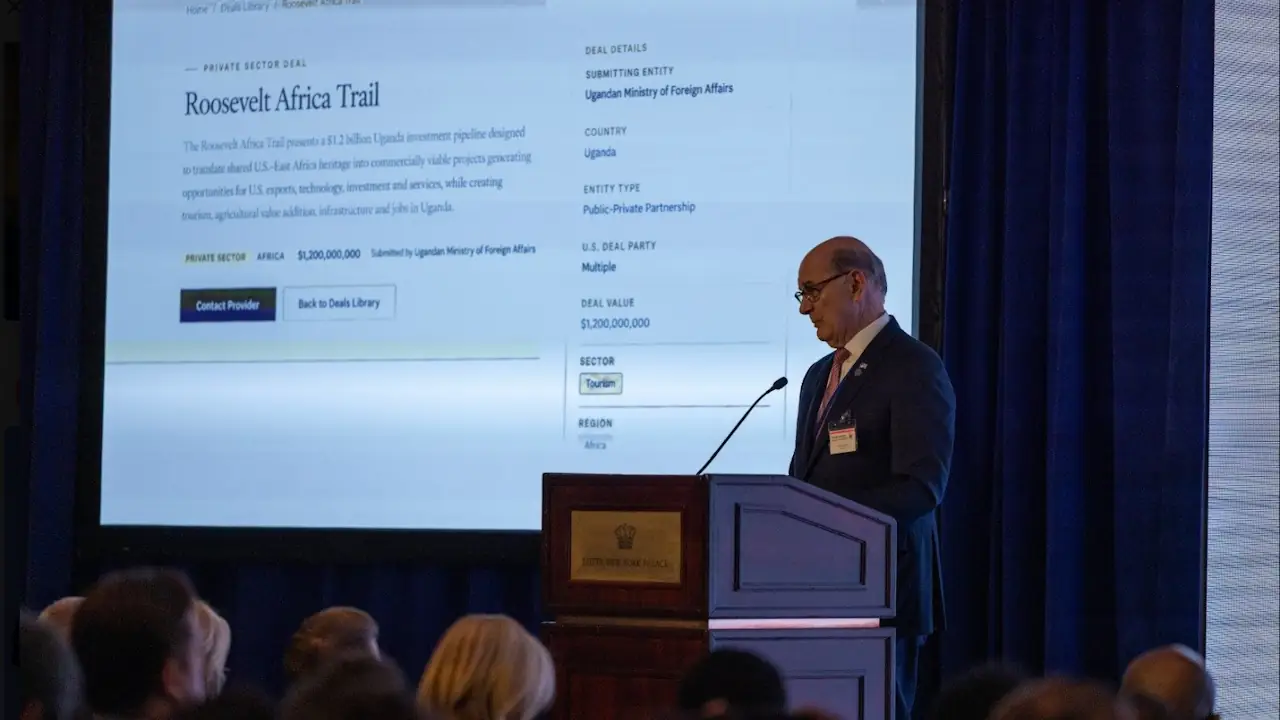

Promoters of the Roosevelt Africa Trail presented an indicative $1.2bn (Shs4.7tn) pipeline of tourism, infrastructure, agriculture and technology proposals to US officials and investors on 25 September, pitching it as the first entry in the US State Department’s emerging Trade Over Aid Deals Library. Published US government material does not, however, confirm either the $1.2bn valuation or that designation, bne IntelliNews reported.
The showcase was held at the Lotte New York Palace during the 81st UN General Assembly’s high-level week. The $1.2bn is the combined indicative value organisers assigned to the proposed Ugandan projects, not committed capital: individual projects still need feasibility studies, eligibility checks, due diligence and financing approval. Organisers have not published a project-by-project breakdown supporting the valuation, and no feasibility studies, financing applications or binding commercial agreements have been identified.
The trail is a regional initiative spanning Uganda, Kenya and South Sudan, but organisers say the $1.2bn pipeline applies to Uganda alone, with Kenya and South Sudan expected to develop separate national proposals. Kenya’s deputy UN representative, Yabesh Monari, and South Sudan’s UN ambassador, Cecilia Adeng, joined regional discussions on 10 September, though neither country has announced a priced pipeline or committed financing of its own.
It is named for Theodore Roosevelt, the former US president, who led a Smithsonian Institution expedition through present-day Kenya, Uganda, the then-Belgian Congo and Sudan in 1909-10, collecting more than 23,000 natural-history specimens. Organisers want to turn the expedition’s route through Buganda, Bunyoro and Murchison Falls into a heritage trail they say will stretch more than 1,000 miles, promoting Ugandan tourism, coffee and trade with the US.
Uganda’s pipeline includes a proposed Roosevelt Africa Museum of History and Science with a library, resort and wider destination development; digital “Smart Monuments” and infrastructure; tourism and hospitality development; and Roosevelt Africa Safari Coffee, which aims to move Ugandan coffee beyond raw-bean exports into roasting, packaging and branded products for the US market. Organisers say Keurig has expressed interest in the coffee proposal and that they are pursuing a letter of intent with Kahawa 1893, though neither company has publicly confirmed a binding agreement; Kahawa 1893’s existing coffee pods are already sold through Keurig’s own retail platform, a separate and established commercial relationship.
Deputy Secretary of State Christopher Landau led the US delegation at the showcase, with UN Ambassador Mike Waltz, Export-Import Bank (EXIM) president and chairman John Jovanovic, and Dan Negrea, the US representative to the UN Economic and Social Council, also participating. Representatives of the US International Development Finance Corporation (DFC) also attended. Uganda was represented by Foreign Minister Adonia Ayebare, Washington ambassador Robie Kakonge and officials from its UN mission.
The Deals Library lists the pipeline as a public-private partnership, with organisers naming EXIM, the US International Development Finance Corporation (DFC) and private investors as potential financing channels for qualifying projects. But the attendance of senior US officials at the event should not be read as a financing commitment, because none of the projects has entered formal EXIM or DFC appraisal.
Landau, who also chairs the DFC’s board, said at the showcase that the US government aims to act as an intermediary between American private capital and opportunities abroad, rather than deploy the capital itself, and called for the array of US agencies involved to become “more of a one-stop shop.” He framed the wider Trade Over Aid initiative as a shift away from aid programmes that “come with strings” towards investment partnerships he called the “heartland” of his job.
The showcase followed a 10 September meeting at Uganda House in New York, where Negrea backed advancing the initiative through the Trade Over Aid framework and said it would become the first entry in the emerging Deals Library — organisers have been seeking high-impact proposals valued at $50mn or more.
The pipeline lands while Uganda remains excluded from the African Growth and Opportunity Act, the preferential US trade programme it lost access to in January 2024 after Washington objected to the 2023 Anti-Homosexuality Act. Uganda Business News reported this month that Kampala signed a non-binding Trade Over Aid declaration in April, one of six African governments to do so, and is separately lobbying for AGOA’s reinstatement.
Organisers said the next stage is to split the pipeline into individual projects, complete feasibility work and identify Ugandan and US partners. The eventual investment value will depend on which projects secure binding finance or commercial contracts.
($1 = Shs3,922.86, Bank of Uganda rate, 25 September)