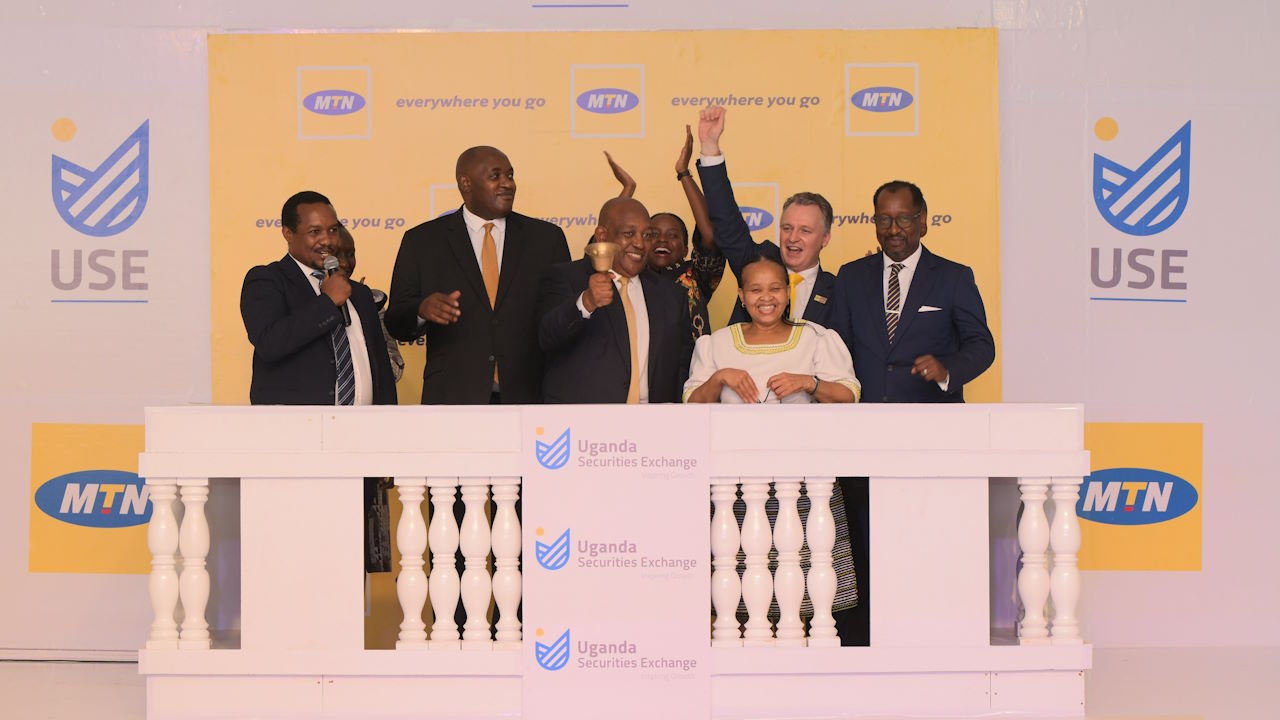

MTN Uganda’s mobile money fintech unit, MoMo, has long been a key source of revenue for the telecom. Yet, its recently announced separation into a private trust raises pressing questions for investors and regulators. The Uganda Securities Exchange received the formal disclosure Wednesday, marking a potential shift in ownership dynamics and regulatory oversight.
This follows MTN Uganda’s initial public offering in 2021, when investors were assured that the fintech business was fully integrated into the telecom. This was in contrast to Airtel Uganda, whose mobile money unit was separate at the time of its IPO. The fintech business was also included in MTN’s secondary share offering in June 2024, further reinforcing its position within the listed company.
Now, with MoMo’s ownership set to transfer to a private trust, the key issue is clear: the fintech unit will no longer be subject to the rules and disclosures that govern publicly listed companies. Investors are left to weigh the consequences — without a clear economic rationale from MTN.
What does this mean for investors?
MTN Uganda’s decision leaves investors facing critical uncertainties:
- How should investors view this change?
- The company’s announcement did not provide financial projections or strategic justification for the shift.
- With limited transparency, shareholders may struggle to assess how this restructuring benefits the broader business.
- Investor protection and market transparency in question
- MTN Uganda’s IPO positioned MoMo as a vital part of the publicly traded company, giving investors confidence under Uganda’s capital markets regulations.
- If moved to a private trust, MoMo may no longer adhere to regular disclosure requirements, potentially limiting access to financial updates and board decisions.
- Will regulators approve the restructuring?
- The current trend favors increased capital market participation for Ugandan investors (MTN, Airtel, QCIL, Standard Bank, etc.).
- Approval for MoMo’s transition into a private trust could signal a retreat from transparency, countering expectations for investor inclusion in high-growth fintech ventures.
Market response: two scenarios
Investors are reacting with caution, but two distinct perspectives have emerged:
Scenario 1: Bearish investors
- Price impact: MTNU’s share price dropped 3.3 per cent in one day (Shs270 to Shs261), with 2.8 million shares traded. This decline aligns with typical stock movements post-dividend payout, but further drops could occur as more investors digest the announcement.
- Risk: Prolonged uncertainty may trigger additional sell-offs , deepening price declines.
Scenario 2: Bullish investors
- Price potential: If investors view this transition as unlocking new fintech opportunities, MTN Uganda’s share price could recover or even rise.
- Risk: Timing concerns. MTN’s announcement suggests that MoMo may not list on the USE for another 3–5 years, keeping investor expectations in limbo.
Larger risks investors should consider
Beyond immediate share price movements, the structural change raises fundamental concerns about governance and investor rights:
Limited liquidity and valuation uncertainty
Investors have no details on how the separation will affect MoMo’s future valuation or operational performance.
Reduced transparency
A private trust means fewer regulatory safeguards, no mandatory disclosures, and limited investor access to critical financial reports.
Weakened minority shareholder protections
For small investors and institutions like NSSF, there’s no guarantee their interests will be fully represented in the trust’s governance structure.
A step forward or backward for Uganda’s capital markets?
The absence of a clear strategic rationale for this shift leaves investors navigating an uncertain path. MTN’s move toward a private trust raises fundamental questions about market transparency, investor protection, and regulatory oversight.
Will this transition unlock fintech innovation or erode investor trust? The answer will shape Uganda’s financial markets for years to come.
Disclaimer:
Crested Stocks and Securities (TA “Crested Capital”) is a licensed broker, dealer, and transaction advisor, regulated by the Capital Markets Authority of Uganda and authorised to trade on the Uganda Securities Exchange.