
Issued by: WMC Africa
Excitement and anticipation are mounting as eight exceptional schools from across Uganda gear up for the grand finale of the 2025 Stanbic National Schools Championship (NSC), also known as the Battle of Champions. This year’s event is set to take place on 29 August at the Mestil Hotel in Kampala.
Now in its tenth year, the competition has evolved into a vital platform for nurturing young entrepreneurs and innovators in Uganda.
After a rigorous seven-month journey, the event will culminate in a competition that has attracted over 500 students from more than 150 schools.
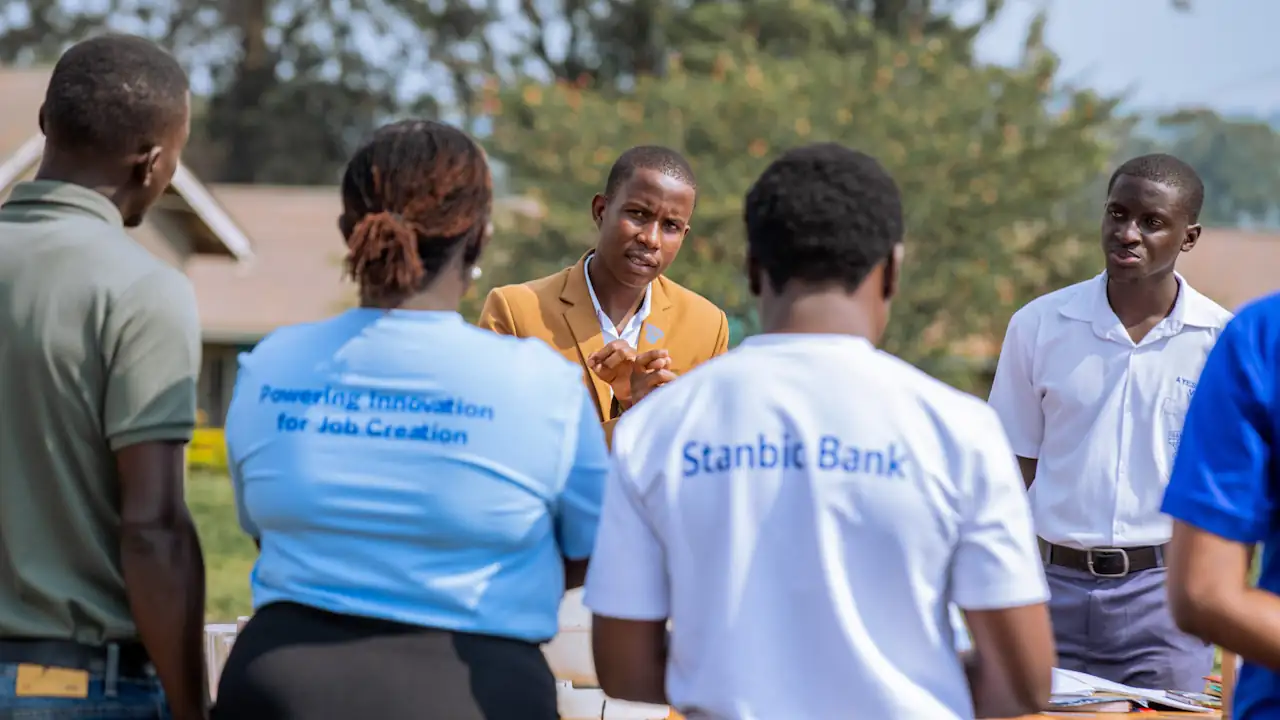
These young innovators have developed solutions to real-world challenges ranging from health and energy to agriculture. The finalists were selected following an intense boot camp held in May at Seroma Christian School in Mukono District, where more than 90 schools were eliminated within the first three days.
“We entered the boot camp with 150 secondary schools in the Student Spark category (students currently in school) and 12 businesses from the Business Fellowship category comprising of NSC Alumni. The competition saw eliminations from 150 to 90 schools, then down to 60, and by the end of the seventh day at the boot camp, only 16 schools remained. As of today, we have only two schools representing each region, making a total of eight schools qualifying for the grand finale,” said Cathy Adengo, head of sustainability at Stanbic Bank Uganda.
Among the finalists is St. Noah SSS Mawaggali, whose project, the WalkMate Smart Glasses, aims to improve the mobility and independence of visually impaired individuals by combining smart glasses, a locator and a smart cane to create a comprehensive navigation system.
Other standout projects include: Summayya High School’s UTI detector, which helps identify urinary tract infections early.
Sacred Heart Secondary School in western Uganda are competing with an automatic drinking water pumping system for institutions, which they prototyped in February 2025 and have sold two units of so far.
Also from the west is Ibanda Secondary School, which has developed scented insect-repellent candles made from coffee and cloves for markets such as lodges and supermarkets.
Representing Eastern Uganda, St Mary’s Girls Secondary School Mandera is showcasing an innovative diabetes testing kit that enables flexible blood sugar monitoring, while Musana Vocational High School has produced an independent power source that requires no gasoline, solar power, natural gas or wind power to operate.
Representing the Northern region is Comboni College Lira with a smoke-free electric generator designed to address power shortages in rural areas, and Mentor Secondary School with an automated patient monitoring device for use in healthcare settings to manage intravenous therapy.
Diana Ondoga, head of social corporate investment at Stanbic Bank, highlighted the importance of the competition in shaping the mindset of Uganda’s youth. “The NSC aims to equip young secondary and vocational school students with entrepreneurial and practical skills, fostering innovation and problem solving,” she said.
She added that the Stanbic National Schools Championship has impacted over 500,000 students, inspiring the creation of over 200 businesses and contributing to the country’s economic transformation.
The initiative also aligns perfectly with Uganda’s National Curriculum, particularly the Competency-Based Curriculum (CBC), which emphasises the essential skills, knowledge, values and attitudes for success in the real world.
As the grand finale approaches, she revealed that the winning school will receive a solar panel worth Shs20m, the runner-up will receive a water system worth Shs10m, and the two schools that come in third and fourth will win scholastic materials.
There is also a commemorative prize of an all-expenses-paid trip to Johannesburg, South Africa, for two students and their teacher.
She concluded by saying that, given Stanbic Bank’s strategy of focusing on women, young people and farmers, this project addresses the needs of young people by equipping them with the practical skills needed to tackle unemployment.