
On a recent morning at the Kiryandongo reception centre in north-western Uganda, palpable exhaustion hung in the air as newly arrived refugees, mostly women and children, lined up in the shade to receive assistance. Moving among the crowd is Abdalla Mohamed, offering translation services and guidance on where to go and what to do next to families.
The 53-year-old Sudanese father of four knows this feeling all too well. He arrived in February this year with nothing but his family and the hope of safety. Now, he spends his days helping others.
“I volunteer at the reception centre and use my English language skills to help interpret for new arrivals,” he said. “I also help the community by connecting the most vulnerable people with the relevant aid agencies. Instead of sitting at home, I thought I could be of help to my people. The reception centre is overcrowded, and I see so many people in need of help every day.”
Since the beginning of 2025, an average of 600 people, primarily from Sudan, South Sudan, and the Democratic Republic of Congo, have arrived in Uganda daily. The East African country currently hosts almost 2 million refugees, more than half of whom are children. The strain is evident everywhere, from overcrowded reception centres and classrooms to inadequate food supplies and health care services. Malnutrition rates, particularly among children under five, are rising at an alarming pace.
“People are arriving in large numbers,” said Abdalla. “The assistance they are receiving is not enough, and they don’t have money to buy anything. There are vulnerable people, including the eldery and children, who are separated from their families. They live in overcrowded shelters with insufficient water.”
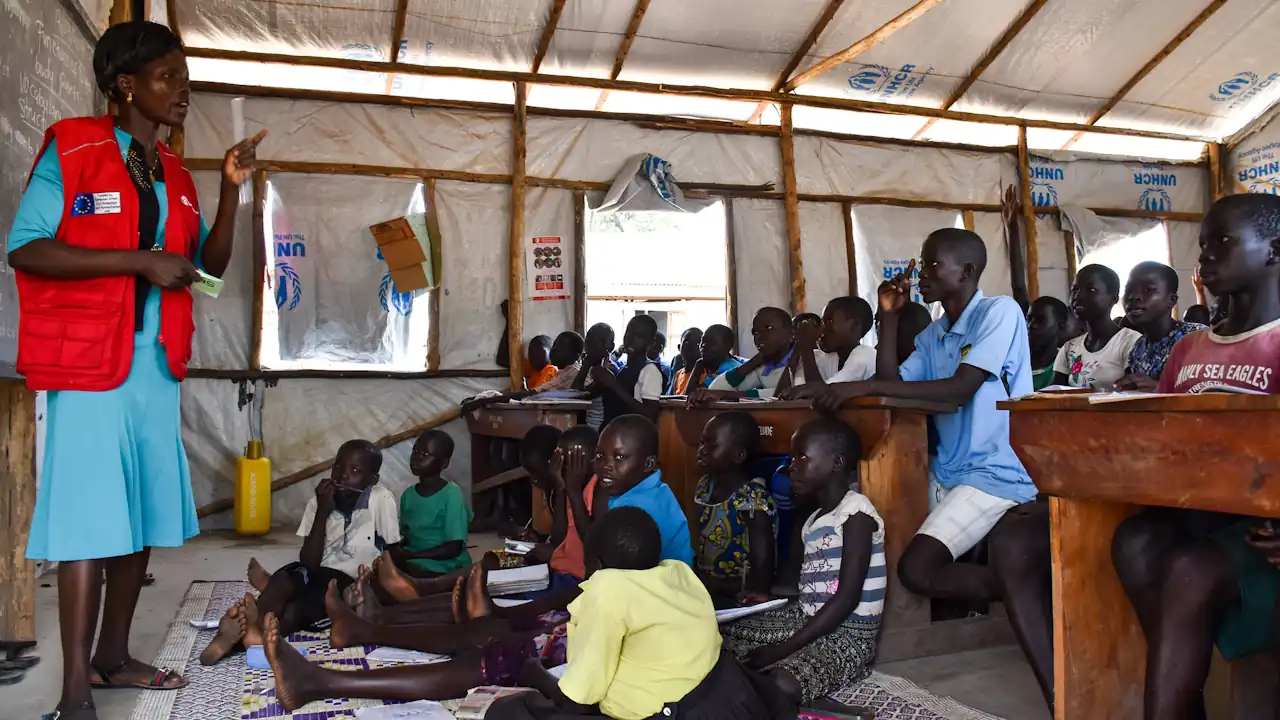
Despite the dire humanitarian situation and limited services, the refugees’ determination to rebuild their lives and regain a sense of normality remains strong, as do the wishes of children to continue their education. Schools in the settlement are filled with eager learners crammed into overcrowded classrooms with limited resources.
“Even before the current situation, the schools were overcrowded,” said Sarah Baako Taban, a 43-year-old South Sudanese refugee teacher. “It is worse now. In one of my classes, I teach over 230 students. I don’t have enough space to walk to reach some of the students at the back. I can only do so much. You wouldn’t even know what was happening at the back of the classroom, but we have no choice; we have to keep teaching despite the challenges.”
One of Sarah’s students is Sojoud Ibrahim, an 18-year-old from Nyala in Sudan’s South Darfur region. The war tore through her hometown, scattering her friends and shattering her dreams of becoming a designer. Her family sold their home to pay for transport to escape. She was in secondary school, but in Uganda she has had to start again, being placed several years back in primary school to adjust to a new curriculum.
However, her determination to resume her education and fulfil her dreams remains undiminished. “I am still strong and have not been destroyed, and my father supports me,” she said. “When the war happened, we managed to come here. I miss my friends. I don’t know if they survived. I want to continue with my education, complete high school and become a designer.”
In its annual Refugee Education Report published on 9 September, UNHCR, the UN Refugee Agency, warned that deep cuts to humanitarian and development aid are putting recent gains in refugee education at risk, with nearly half of school-age refugee children still unable to attend school.
UNHCR is working with the Ugandan government and partners to provide life-saving assistance despite dwindling funds. The agency recently reported that by the end of July, it only had sufficient resources to support fewer than 18,000 individuals with cash and essential relief items, enough to cover just two months of new arrivals at the current pace.
“Emergency funding will run out in September,” said Dominique Hyde, UNHCR’s Director for External Relations, who recently visited settlements hosting Sudanese and South Sudanese refugees in Uganda. “More children will die of malnutrition, more girls will fall victim to sexual violence, and families will be left without shelter or protection unless the world steps up. Uganda has opened its doors, its schools, and its health centres. This model can succeed, but it can’t do it alone.
With peace in their homelands still a distant hope, refugees like Abdalla are working tirelessly to rebuild their lives. However, without urgent support, their resilience alone cannot sustain them.
“Please continue to help us, we need more support,” said Abdalla. “I know the world has a lot of problems but try to help us now. Maybe in a few years, Sudan will become peaceful.”
Distributed by APO Group on behalf of the United Nations High Commissioner for Refugees (UNHCR).