

Strong currencies have helped curb inflation in several sub-Saharan African countries, giving central banks room to ease interest rates and support business activity.
A recent analysis by S&P Global, the US financial data group, found that five of the seven economies it tracks — including Uganda — have seen their currencies appreciate against the US dollar this year. The Ghanaian cedi and the Zambian kwacha have been the most resilient, each gaining 15 per cent against the US currency by the end of September.
The Ugandan shilling was up 5.2 per cent year-to-date through September, continuing a trend of strength against the dollar. It also appreciated 5.5 per cent year-on-year in September, according to Bank of Uganda data.
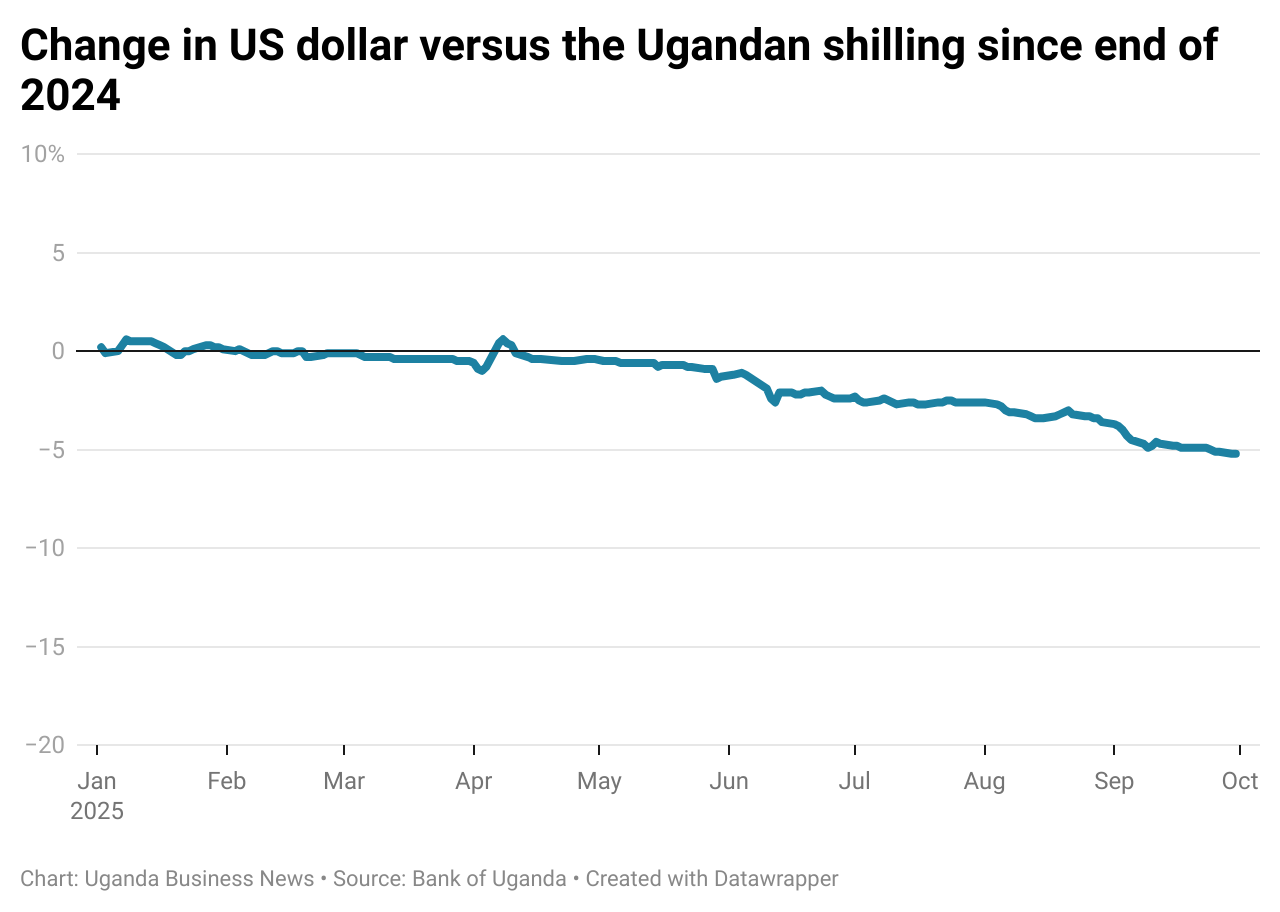
BoU attributes the shilling’s performance to “stable” inflows from abroad and a “gradual shift in global trade transactions away from the dollar”. The S&P report also cites the dollar’s weakness, alongside support from International Monetary Fund programmes, fiscal consolidation, and tight monetary policy.
The countries covered by the analysis are Uganda, South Africa, Nigeria, Kenya, Ghana, Zambia, and Mozambique.
The stronger currencies have contributed to a “sustained easing of inflationary pressures” in the region’s economies, said the analysis, which draws on purchasing managers’ indices data. The data showed that production-related expenses rose at the slowest pace in September since the Covid-19 pandemic. Selling prices increased, but at one of the slowest rates recorded in the past five years.
S&P added that businesses in most regional economies have experienced either a slowdown or an outright decline in purchase price inflation during the year. Ghana and Zambia, whose currencies have appreciated the most, “have recorded periods of decreasing purchase prices”.
“Such price falls are rarely seen among the sub-Saharan Africa PMIs, which normally suffer from marked inflationary pressures,” it added.
Purchasing managers typically cite exchange rates — especially the dollar — as the cause of rising purchase prices, as currency pressures inflate the cost of imported goods and merchandise denominated in US dollars. However, between June and August, exchange rates and dollar movements were cited more often as drivers of price declines than increases — a first since S&P began conducting PMI surveys across all seven countries.
Over the past few months, there have been “above-average mentions of either exchange rates or the dollar causing a drop in purchase prices”. The only other time purchasing managers mentioned that more was in April 2024, when the Kenyan shilling rallied particularly strongly against the dollar.
In response to the slowdown in inflationary pressures, central banks across the region have lowered interest rates. According to the analysis, interest rates were lower at the end of September than at the beginning of the year in five of the seven economies. Most notably, Ghana’s central bank reduced its policy rate by 650 basis points at its last two meetings.
Only Uganda, where the central bank rate has remained unchanged since January, and Zambia, which posted an increase, bucked the trend. However, S&P expects Zambia to cut its policy rate by between 0.5 and 1 percentage point next month. BMI, a subsidiary of Fitch Solutions, forecasts a 25-basis-point reduction in the Bank of Uganda’s policy rate to 9.5 per cent by the end of the year, citing softening inflation expectations and easing in peer markets, according to an August note.
At the same time, output and business activity have picked up in the region, according to S&P. September saw the fastest increase in output in five months, driven by a rise in new orders. Employment rose for the twelfth consecutive month, as firms increased their purchasing activity and inventory levels.
Business conditions in Uganda strengthened for the first time in four months due to a sustained rise in new business, driven by favourable demand conditions and an increase in the number of customers, according to September’s PMI data. This led to a rise in output — the eighth increase in as many months.
“The only economy covered by PMI data to see a drop in output during September was Ghana, but even here new orders expanded, and business confidence remained elevated, meaning that we could potentially see renewed growth in the months ahead,” the analysis said.