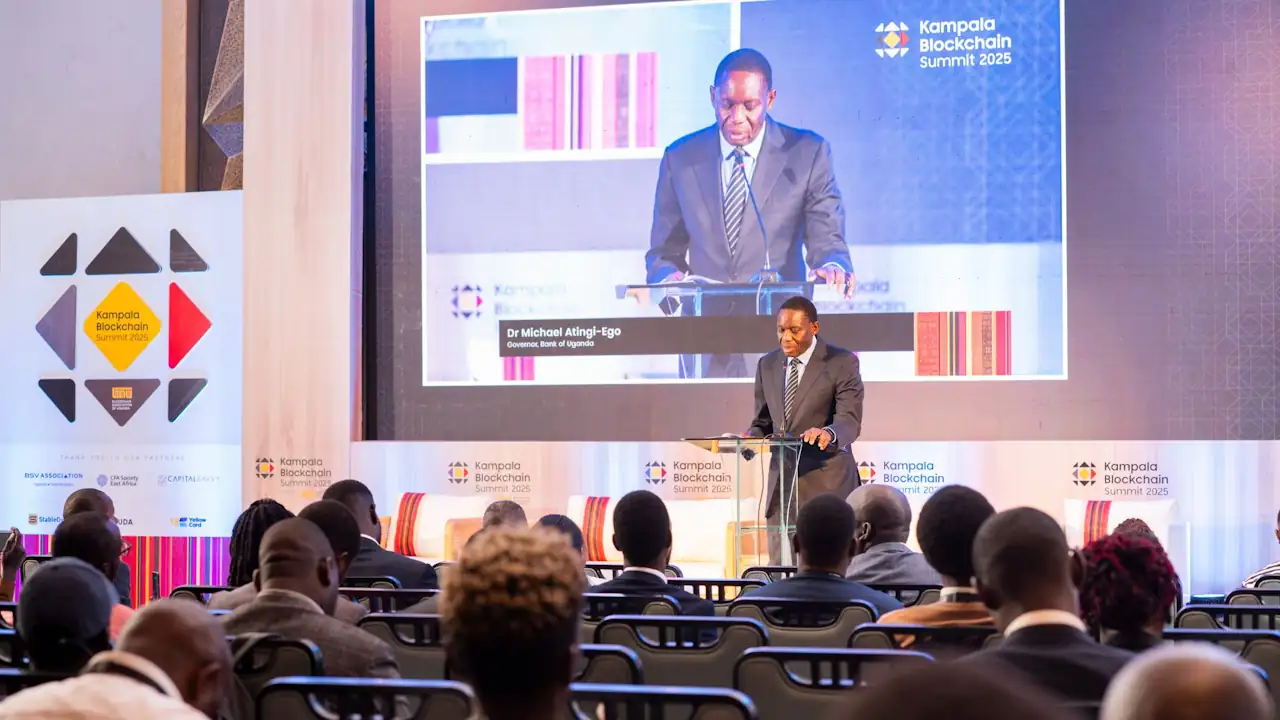
Keynote speech of Michael Atingi-Ego, Governor, Bank of Uganda – as prepared for delivery
At the Kampala Blockchain Summit 2025
Theme: “From Regulation to Growth: Uganda as a Regional Hub for Virtual Assets”
Four Points by Sheraton, 25 November 2025
Distinguished dignitaries, colleagues, and ladies and gentlemen, good morning.
It is an honour to address this third edition of the Kampala Blockchain Summit. We meet at a pivotal moment for Uganda’s financial future, when the decisions we make today will shape the structure, safety, and competitiveness of our economy for decades ahead.
To the Blockchain Association of Uganda: you have gathered us not just to observe innovation, but to shape it. This is not merely the third annual summit. It is the third step in a journey that will determine whether Uganda leads or follows in the digital transformation of finance.
Your theme — ‘From Regulation to Growth: Uganda as a Regional Hub for Virtual Assets’ — asks a defining question: can we embrace innovation with boldness while safeguarding stability with wisdom? These are not rhetorical questions. They require real answers, forged through collaboration between regulators, industry, and the wider public.
We live in a time when a month in digital innovation can alter entire business models. Blockchain sits at the centre of this acceleration. Technologies that were once considered theoretical, such as tokenised securities, programmable money, tokenised commodities and blockchain-based cross-border payments, are now operational in advanced markets. These technologies are reshaping how value is stored, moved, and trusted.
The question for Uganda is no longer whether these technologies matter. Rather, it is a question of whether we will be architects of their adoption or mere users of systems designed elsewhere.
Uganda’s stance: Prudence, not hesitation
For years, Uganda has been characterised as cautious towards cryptocurrencies. Let me clarify: our stance has not been hesitation — it has been prudence.
We have publicly stated that virtual assets are not legal tender and that participation is at one’s own risk. Some interpreted this as conservatism. But what is conservative about protecting millions of citizens from products they may not fully understand? What is obstructionist about insisting that innovation must not outpace consumer protection?
This was not a prohibition. It was a deliberate pause to build understanding before establishing a clear, enforceable regulatory framework.
During this period, the Bank of Uganda collaborated with other regulators and with the Blockchain Association to build technical capacity and study global standards. Through the Financial Sector Stability Forum, a technical working group was formed to assess use cases, risks, and mitigation measures across the sector. And just weeks ago, the Financial Intelligence Authority concluded a comprehensive national risk assessment of virtual assets and virtual asset service providers.
What the risk assessment shows
Let me share its key findings.
Virtual assets in Uganda present significant risks, primarily due to limited customer due diligence, weak governance structures and an informal ‘shadow’ system operating without oversight.
One data point stands out: 84.5 per cent of virtual asset activity in Uganda occurs on decentralised platforms, far above the Sub-Saharan average of 63.8 per cent. This means that the majority of Ugandan users operate in environments where supervision is technically challenging, and consumer recourse is practically non-existent.
Stablecoins are widely used for remittances and cross-border payments. Their appeal is understandable, but their implications are serious. They carry foreign exchange risks and create monetary substitution, whereby Ugandans hold value in foreign-pegged digital instruments rather than the Uganda Shilling. These issues are too consequential to ignore.
The message is clear: regulatory uncertainty is no longer tenable. But equally, outright prohibition is neither desirable nor effective.
History shows that bans do not eliminate demand; rather, they drive activity underground, amplifying consumer risk and removing opportunities for oversight. Kenya learned this before passing its recent comprehensive virtual asset legislation. Innovation did not stop, it simply moved out of sight, resulting in increased fraud and reduced transparency.
Uganda must not repeat that experience.
Learning from Kenya: A regional turning point
To understand our path forward, it is useful to examine developments among our neighbours.
On 4 November 2025, Kenya began implementing the Virtual Asset Service Providers Act — a landmark achievement for financial regulation on the continent.
Kenya’s experience offers three key lessons:
Firstly, comprehensive virtual asset legislation is achievable in an African context. When national interest aligns behind clear objectives, capacity, political will and coordination are not barriers.
Secondly, Kenya adopted a functional regulatory model. The Central Bank oversees virtual assets used for payments, while the Capital Markets Authority supervises those used for investments. This recognises a simple truth: identical technology can produce different economic risks.
Thirdly, Kenya provides clarity. Nine categories of virtual asset activity, from exchanges to custodial wallets to tokenisation platforms, are explicitly licensed and supervised. Guesswork has been replaced by clarity, providing legitimate businesses with a roadmap, protecting consumers, and equipping regulators with effective tools.
Kenya’s journey also highlights the cost of delay: years of grey-zone activity resulted in underground transactions, consumer losses, and limited visibility for authorities. Uganda faces the same risk unless decisive action is taken soon.
The path forward for Uganda
Our goal is to find a balance between innovation and stability. Rather, we aim to achieve both through proportionate, well-calibrated regulation that is aligned with both global standards and regional realities.
Uganda’s regulatory framework must rest on six foundational pillars:
- Licensing and fit-and-proper standards: Only qualified and trustworthy providers should be permitted to operate. Licensing must apply to both institutions and key personnel, with ongoing assessments of integrity, competence, governance, and capital adequacy
- Client asset protection: Providers must segregate client assets, maintain adequate capital, and prevent customer funds being used for proprietary trading. Global failures, from Mt. Gox to FTX, underline the cost of weak safeguards
- AML/CFT compliance: The FATF Travel Rule, suspicious activity reporting, and full transparency are essential. The FIA must have real-time visibility of virtual asset flows
- Cybersecurity and operational resilience: As these assets only exist digitally, cybersecurity is not optional — it is existential. Requirements must include cold storage, independent audits and tested business continuity plans
- Market integrity and conduct: In order to build a fair market, it is essential to protect against wash trading, pump-and-dump schemes, misleading advertising and rug pulls
- Transparency and data reporting: Regulators require real-time, read-only access to transaction data. Aggregated market information should be published to support research, policymaking, and public trust.
These pillars are not theoretical. They are the backbone of every jurisdiction that has safely integrated virtual assets into its financial system.
Who should regulate?
Regulatory architecture is not a footnote — it determines effectiveness.
We should learn from Kenya’s model: a clear division between the BoU (payments) and the Capital Markets Authority (investments), with the Financial Intelligence Authority integrated to strengthen oversight and risk management — all coordinated through the Financial Sector Stability Forum.
Effective coordination will require clear mandates, memoranda of understanding, joint supervisory teams and dispute resolution mechanisms.
Regulation succeeds not when one institution does everything, but when every institution does what it does best.
The role of sandboxes
Uganda already operates regulatory sandboxes through the Bank of Uganda and the Capital Markets Authority. These provide a controlled environment in which to test innovations, assess risks and inform regulatory design.
I encourage innovators and financial institutions to make active use of these sandboxes. This is how we learn before we legislate, and how we design rules grounded in experience rather than speculation.
Direct appeal to stakeholders
Allow me to address all the groups represented here directly.
To industry:
Engage constructively. Share yout expertise. Embrace regulation as the foundation of sustainable and trustworthy businesses.
To regulators:
Build capacity, avoid reflexive rule-making and coordinate tightly. Regulation must be rigorous, proportionate, and evidence-based.
To consumers:
Be vigilant. Avoid guaranteed-return schemes. Invest only what you can afford to lose, but remain open to opportunities that emerge under a safe, supervised framework.
To international partners:
Support us with training, technology and expertise, while respecting Uganda’s context and capacity.
The uncomfortable question we must confront
Returning to today’s theme, ‘From Regulation to Growth: Uganda as a Regional Hub for Virtual Assets’, there is a pressing question that should keep us awake at night and fuel our urgency at this summit: How can Uganda position itself as a regional leader in virtual assets when Kenya is already ahead of us?
This is not a question I pose lightly. The conference theme boldly presents Uganda as a regional hub. But let us be honest about where we stand.
Kenya has comprehensive legislation. We are still developing ours.
Kenya has begun licensing its first virtual asset service providers. We have none.
Kenya has regulatory clarity that allows businesses to plan, consumers to participate with protection, and regulators to supervise effectively. We are still building that clarity.
So, I ask all of you in this room, whether you represent industry, civil society, academia or government, what Uganda’s competitive advantage will be. What can we offer that Kenya cannot? How will we differentiate ourselves? Why would a virtual asset firm choose Kampala over Nairobi? And why should international investors look to Uganda as their gateway to East Africa when Kenya has already opened its doors?
These are not rhetorical questions. They are strategic questions that demand concrete answers. The answer is not simple. It will not happen automatically. It won’t just happen because we declare it as an aspiration.
At this moment, as a regulator, I dare say that Uganda becomes a regional hub by:
- Moving deliberately but urgently to implement comprehensive, high-quality legislation
- Investing heavily in world-class supervisory capacity
- Specialising in areas of comparative advantage
- Building a complete ecosystem of talent, infrastructure, and expertise
- Positioning ourselves strategically within regional integration frameworks
- And above all, by refusing to accept that being second to legislate means accepting permanent second-tier status
Kenya has shown what is possible. Now, Uganda must show what is achievable with intelligence, determination, and strategic focus.
The question this conference asks is whether we can transition from regulation to growth and whether Uganda can become a regional hub. I am here to tell you: yes, we can. However, this will only be possible if we confront where we are honestly, think strategically about differentiation, move with both urgency and quality, and if every stakeholder — regulator, industry, academia and civil society — commits to this vision with concrete action rather than aspirational rhetoric.
Our goal is not to choose between innovation and stability. Our goal is to achieve both through proportionate, well-calibrated regulation that is aligned with both global standards and regional realities. That is my take on this vital topic – what is yours?
Conclusion
The choices we make today will define Uganda’s digital financial landscape for a generation. We have strong institutions, political will and committed stakeholders, as well as a clear regional example right on our doorstep.
Uganda does not need to follow. It is ready to lead by building a regulatory framework that protects consumers, supports innovation, strengthens stability, and positions our country as a responsible virtual-asset hub for Africa.
Let us build a digital financial future worthy of Uganda’s talent, creativity, and ambition.
Thank you, and God bless.