
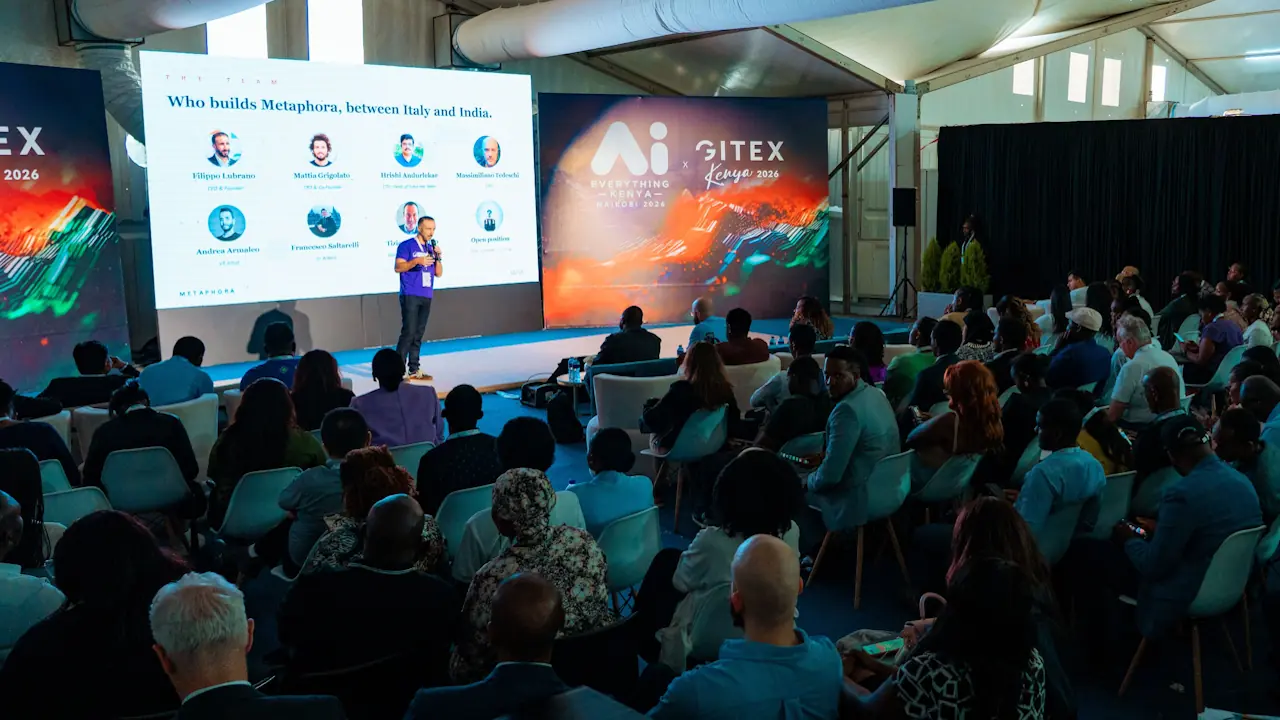
East Africa’s largest AI summit ended in Nairobi on Thursday with its attention fixed less on opportunity than on the gaps that remain: in public trust, in startup capital, and in the intellectual property frameworks that determine who ultimately profits from innovation.
The third and final day of AI Everything Kenya × GITEX Kenya drew together technology executives, government officials, venture investors and international institutions at the Kenyatta International Convention Centre, closing an inaugural edition that attracted more than 280 enterprises and startups, 120 speakers and 100 investors managing a combined $50bn in capital, with delegates from 75 countries.
Governments and the trust deficit
A session on AI-enabled public services produced some of the day’s most direct commentary. Ntuthuko Ndamane, Director of Information Technology Management Services at KwaZulu-Natal’s Department of Transport in South Africa, argued that public trust is built — or lost — through everyday service encounters rather than policy announcements. “Trust is emotional; it does not collapse through public documents or political rhetoric, but through lived experiences,” he said, adding that digitising public services must prioritise transparency, interoperability, and citizens’ ability to contest decisions.
James Ayugi, chief executive of e-Citizen, offered a simpler measure: availability. “Every time citizens log into a government platform and the service is available, and when they apply and get a service every single time wherever they are, it brings trust,” he said. The session examined what governance architecture would be needed to build public systems capable of measuring and correcting service failures in real time — a question with direct relevance across East Africa, where government digitisation programmes have advanced unevenly.
Scaling beyond the prototype
The summit’s Venture Scaling Forum addressed a chronic problem in African technology investment: the gap between promising early-stage companies and the capital structures needed to take them further. Carrie Liauw, Executive Director for Market Launch at 500 Global, said the firm’s focus was building long-term continuity for founders rather than discrete funding rounds. “We see everybody building across every single industry in Africa — and everybody is building because there are real problems to solve,” she said.
Astria Fataki, Strategic Lead for Tech Hubs Design and Development at the United Nations Development Programme, drew on the UNDP’s Timbuktoo Initiative, which works with African governments, investors and universities to support the continent’s startup ecosystem. She argued for what she called conscious capitalism — commercial discipline in service of broader social returns. “What’s needed is a mechanism where we create enough value for innovation and impact to sustain themselves in the long run,” she said.
The patent gap
The most striking data point of the day came from the World Intellectual Property Organization. Despite Africa’s growing reputation as a source of technology innovation, fewer than 500 Patent Cooperation Treaty applications have been filed from the continent in any year since 2013 — including just 458 in 2025. By comparison, China filed more than 70,000 in the same year.
Emir Ali Jazairy, Senior Counsellor at WIPO’s PCT International Cooperation Division, said intellectual property remained “completely invisible” at most African startup events, when it should be a standard part of any founder’s toolkit. He pointed to the PCT mechanism — which allows a single international application to preserve filing priority across multiple countries and delays the cost of national filings by up to 18 months — as a practical tool that most African entrepreneurs are unaware of.
“IP is a strategic asset for startups: it safeguards innovation, increases investor confidence, and creates licensing and commercialisation pathways that generate long-term value,” Mr Jazairy said.
The point carries weight for East African founders in particular, where the combination of active mobile technology development and low IP registration rates means significant commercial value is routinely left unprotected.
Looking ahead
Trixie LohMirmand, chief executive of inD, the global organiser of GITEX, framed the event’s ambition in terms that doubled as a challenge: “Using AI makes you a market. Creating AI makes you a power.” The inaugural edition’s convening of senior African and international figures in Nairobi reflects a broader effort to establish Kenya — and the region — as a participant in shaping AI standards rather than simply adopting them.