
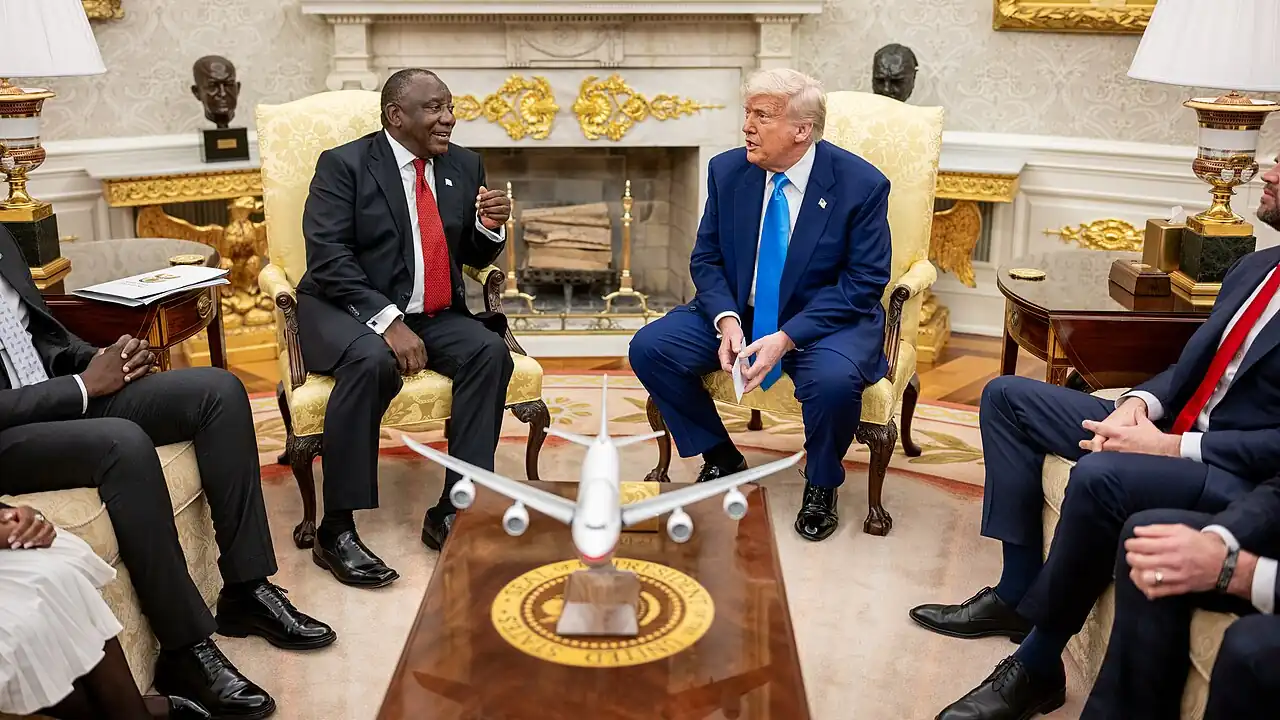
Donald Trump has announced that South Africa will not be invited to next year’s G20 summit in Miami, in what would be an unprecedented attempt to exclude a member state from the world’s premier economic forum.
The US president’s declaration on Wednesday escalated a diplomatic row that began when Washington boycotted last weekend’s G20 summit in Johannesburg — the first ever held in Africa. Trump cited South Africa’s refusal to hand over the G20 presidency to a US embassy representative as the trigger for his decision.
Why it matters: Donald Trump’s threat to exclude South Africa from next year’s G20 summit in Miami represents an unprecedented escalation in diplomatic warfare — but the G20 lacks formal enforcement mechanisms, making it unclear how the US president could actually bar a permanent member.
The context: Trump announced on Wednesday that South Africa would not receive an invitation to the 2026 summit in Miami, claiming that Pretoria had refused to hand over the G20 presidency to a US embassy representative at last weekend’s gathering in Johannesburg.
“South Africa has demonstrated to the World they are not a country worthy of Membership anywhere,” Trump wrote on Truth Social, repeating false claims about a “white genocide” and vowing to “stop all payments and subsidies to them, effective immediately”.
Between the lines: The G20 has no formal charter, membership criteria, or accountability mechanisms. South Africa became a member when the group was formed in 1999, and the composition has remained unchanged since establishment.
Ramaphosa’s government responded sharply: “South Africa is a member of the G20 in its own name and right. Its G20 membership is at the behest of all other members.”
The gavel incident: The diplomatic rupture stems from a ceremonial slight. After the US boycotted the Johannesburg summit, Washington demanded the presidency be symbolically handed to its acting ambassador at the closing ceremony.
South Africa refused, arguing it would breach protocol for Mr Ramaphosa to hand the presidency to a “junior” diplomat. The handover eventually took place at South Africa’s foreign ministry in a low-key ceremony.
The broader campaign: Trump’s actions fit a pattern of punitive measures against African critics of US foreign policy, particularly regarding the Israeli–Palestinian conflict. Earlier this week, Washington revoked the visa of Naledi Pandor, South Africa’s former foreign minister who spearheaded the genocide case against Israel at the International Court of Justice.
The administration has also:
- suspended aid to South Africa
- expelled South Africa’s US ambassador
- granted asylum to Afrikaners based on false claims of persecution
- sanctioned ICC judges and prosecutors who issued arrest warrants for Israeli officials
The bottom line: Whilst Trump can boycott G20 events and potentially use visa restrictions to complicate South Africa’s attendance, he cannot unilaterally expel a member from an informal forum with no formal membership rules. Other G20 members — particularly China, Brazil, and the African Union — would need to acquiesce to any exclusion.
Chris Hattingh of Johannesburg’s Centre for Risk Analysis warned: “There is a risk that the US will pressure other countries to weaken their trade, investment, commercial and diplomatic links with South Africa, lest they also be pushed out of the G20.”
For now, Pretoria has vowed to attend the meeting in Miami regardless. The real test will be whether Washington’s allies support Trump’s unprecedented attempt to weaponise membership of the world’s leading economic forum.