
Ugandan companies servicing the country’s nascent oil sector have been urged to pursue opportunities across East Africa as neighbouring countries advance their own petroleum projects, with officials warning that domestic opportunities will contract sharply once production begins.
Speaking at the close of the 6th Annual National Content Conference in Kampala on Thursday, Jimmy Mugerwa, project manager at the Industry Enhancement Centre, said enterprises faced a critical juncture as Uganda transitions from construction to operations in mid-2026.
“Beyond extraction lies the real opportunity: identifying, preparing for, and capitalising on what is emerging. To get there, we must change speed, change direction, and rewire our approach,” said Mr Mugerwa, adding that success would be measured by “how much value remains here in Uganda”.
The conference highlighted emerging prospects in Namibia, Kenya, and Tanzania, where regulatory frameworks increasingly mandate local participation through joint ventures and partnerships.
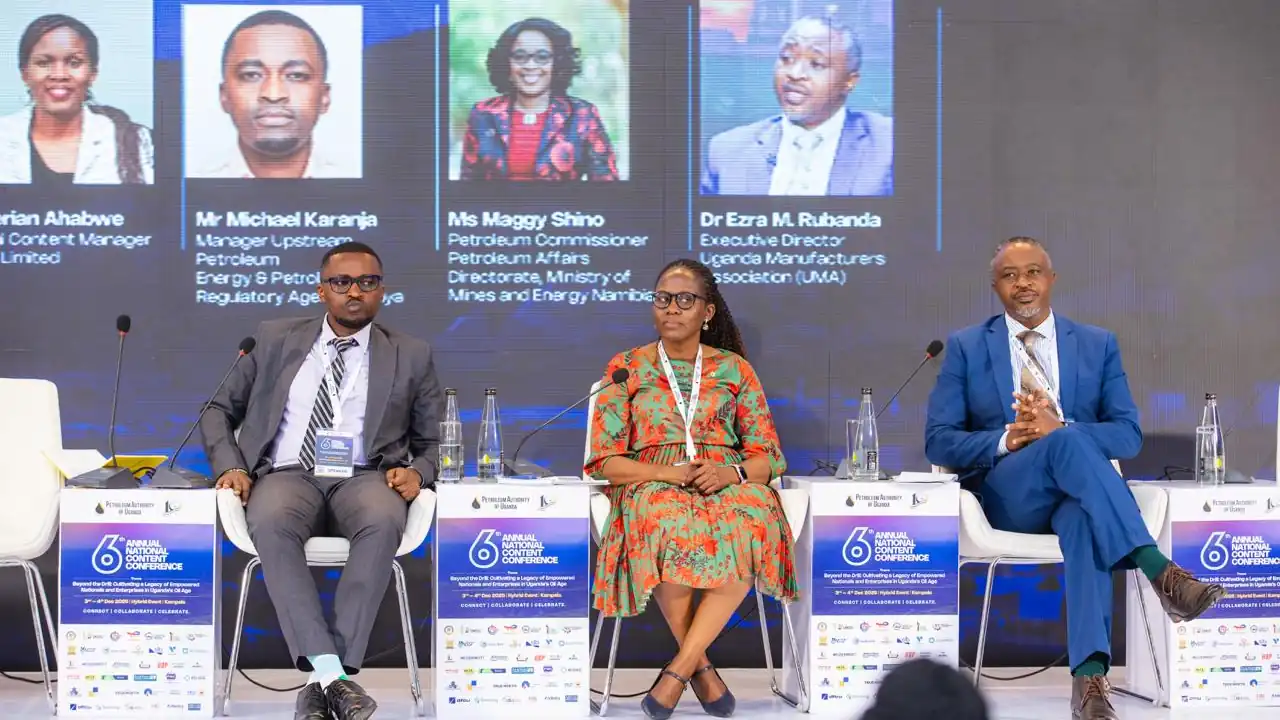
Maggy Shino, petroleum commissioner at Namibia’s ministry of mines and energy, said her country operates an open licensing regime, with mandatory requirements for local partnerships. She cited pipeline construction, fabrication work, and refinery development as areas in which foreign companies could participate during the development phase.
In Kenya, authorities are reviewing field development plans for the Lokichar oil basin. Michael Karanja, manager of upstream petroleum at the Kenya Petroleum Regulatory Agency, said legal provisions governing the sector — including regulations currently being finalised — required enhancement of local content through joint ventures.
“Ugandan companies are well-positioned to harness and explore these opportunities,” said Mr Karanja.
Tanzania has already engaged several Ugandan contractors to work on both sides of the East African Crude Oil Pipeline, according to Merian Ahabwe, EACOP’s national content manager. She added that Tanzanian law requires foreign companies to establish local offices and enter into joint ventures with domestic enterprises.
“There are success stories of Ugandan companies establishing themselves in Tanzania — about five companies so far,” said Ms Ahabwe, noting that EACOP Uganda had provided training for contractors through the Industry Enhancement Centre.
The Petroleum Authority of Uganda has set a target of $5bn in annual export earnings as part of its strategy for the production phase. The strategy also includes commercialising the petrochemical industry, advancing refinery development and the strengthening of links with the agriculture, tourism, and manufacturing sectors.
The two-day conference, which opened on Wednesday, brought together government officials, industry leaders, regulators and financiers to discuss Uganda’s transition from infrastructure development to oil production.
Read: Uganda urges local firms to prepare for oil production phase